Ricardo, J., de Sá, V., & Coelho, A. R. (2021).
DO ARRAIAL, À PROCISSÃO: APLAUSOS NO CORETO E ESPLENDOR NAS VISITAS RÉGIAS. NOVOS PALCOS E NOVAS BANDAS NA ÉVORA LIBERAL DO SÉC. XIX. In V. de Sá, R. T. de Paula, A. F. Conde, & A. C. Gouveia (Eds.), Sonoridades Eborenses (pp. 155-186). Edições Húmus e Autores, ISBN: 978-989-755-688-3. http://hdl.handle.net/10174/32257

ABSTRACT
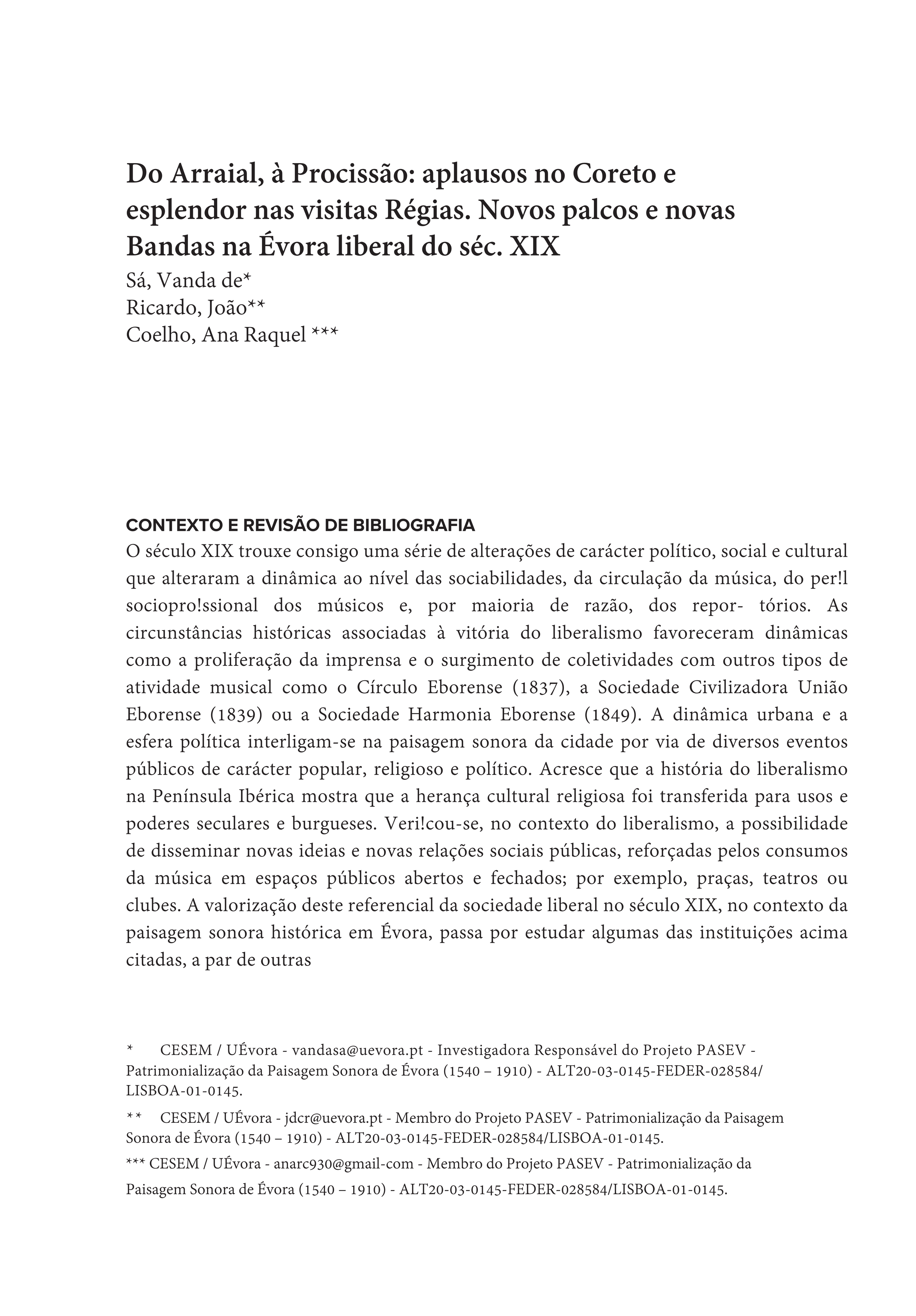
The 19th century brought several political, social, and cultural developments that changed the dynamics at the level of sociability, of music circulation, of musician’s social and professional profile and, for the majority of reasons, of repertoires. It was possible, in the liberal context, to build new ideas and new public social relations, reinforced by the consumption of music in open and closed public spaces (squares, theaters or clubs for example). The appreciation of this benchmark of the 19th century liberal society regarding Évora’s historical soundscape calls for the study of institutions like Casa Pia (1836) and Orquestra de Amadores Eborenses (1886), along with the attendance of military Bands and «Charangas» like Cavalaria 5 or Regimento de Infantaria 17, which performed in the city on important dates. Analysis of events, parties and political circumstances concerning the public performances provide an enlightened setting on the cities’ cultural dynamic, in its religious and civil valency. Also dwells with additional significant information on repertoire and musicians, namely about the circulation and communication with the surrounding cities and with Lisbon, following a constant negotiation of local values, national values, and cosmopolitan openness.
KEYWORDS
Évora, 19th century, Bands, Sociability, Music.
The 19th century brought several political, social, and cultural developments that changed the dynamics at the level of sociability, of music circulation, of musician’s social and professional profile and, for the majority of reasons, of repertoires. It was possible, in the liberal context, to build new ideas and new public social relations, reinforced by the consumption of music in open and closed public spaces (squares, theaters or clubs for example). The appreciation of this benchmark of the 19th century liberal society regarding Évora’s historical soundscape calls for the study of institutions like Casa Pia (1836) and Orquestra de Amadores Eborenses (1886), along with the attendance of military Bands and «Charangas» like Cavalaria 5 or Regimento de Infantaria 17, which performed in the city on important dates. Analysis of events, parties and political circumstances concerning the public performances provide an enlightened setting on the cities’ cultural dynamic, in its religious and civil valency. Also dwells with additional significant information on repertoire and musicians, namely about the circulation and communication with the surrounding cities and with Lisbon, following a constant negotiation of local values, national values, and cosmopolitan openness.
KEYWORDS
Évora, 19th century, Bands, Sociability, Music.